
Safety Profile1
The types, frequency and severity of adverse events were comparable between the biosimilar (QosequTM) and reference biologic drug (EUPROLIA).
Immunogenicity Profile1
As with all therapeutic proteins, there is a potential for immunogenicity. The detection of antibody formation is highly dependent on the sensitivity and specificity of the assay.
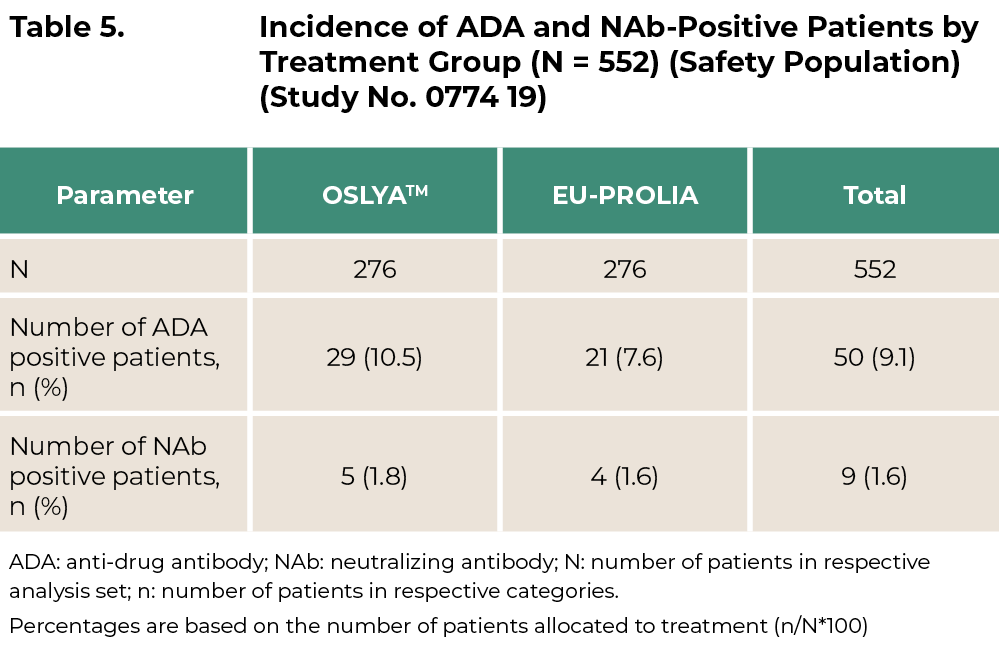
Immunogenicity was evaluated in 552 postmenopausal osteoporosis (PMO) patients as part of Study no. 077419. An enzyme-linked immunosorbent assay (ELISA) based immunoassay was used for detection and confirmation of anti-drug antibody (ADA) in patients, whereas a non-cell based competitive ligand binding (CLB) assay method was used for detection of neutralizing antibody (NAb).
No notable differences were found in ADA responses (both binding and neutralizing) between the QosequTM and EU-PROLIA groups in PMO patients, as per Study no. 077419.
In addition, the ADA-positive and -negative patients showed similar PK and PD behavior.
The incidence of ADA and NAb-positive PMO patients are presented in Table 5 below.
Indications1
Indications have been granted on the basis of similarity between QosequTM and the reference biologic drug Prolia®. QosequTM (denosumab injection) is indicated for :
Postmenopausal Osteoporosis
- For the treatment of postmenopausal women with osteoporosis at high risk for fracture, defined as a history of osteoporotic fracture, or multiple risk factors for fracture; or patients who have failed or are intolerant to other available osteoporosis therapy. In postmenopausal women with osteoporosis, QosequTM reduces the incidence of vertebral, nonvertebral and hip fractures.
Treatment to Increase Bone Mass in Men with Osteoporosis at High Risk for Fracture
- As a treatment to increase bone mass in men with osteoporosis at high risk for fracture, defined as a history of osteoporotic fracture, or multiple risk factors for fracture; or patients who have failed or are intolerant to other available osteoporosis therapy.
Treatment to Increase Bone Mass in Men with Nonmetastatic Prostate Cancer receiving Androgen Deprivation Therapy (ADT), who are at high risk for fracture
- As a treatment to increase bone mass in men with nonmetastatic prostate cancer receiving androgen deprivation therapy (ADT), who are at high risk for fracture.
Treatment to Increase Bone Mass in Women Receiving Adjuvant Aromatase Inhibitor Therapy for Nonmetastatic Breast Cancer
- As a treatment to increase bone mass in women with nonmetastatic breast cancer receiving adjuvant aromatase inhibitor (AI) therapy, who have low bone mass and are at high risk for fracture.
Treatment to Increase Bone Mass for the Treatment and Prevention of Glucocorticoid-Induced Osteoporosis in Women and Men at High Risk for Fractures
- As a treatment to increase bone mass in women and men at high risk for fracture due to sustained systemic glucocorticoid therapy.
- As a treatment to increase bone mass in women and men at high risk for fracture who are starting or have recently started long term glucocorticoid therapy.
Based on the data submitted and reviewed by Health Canada, the safety and efficacy of denosumabin pediatric patients has not been established; therefore, Health Canada has not authorized an indication for pediatric use.
Contraindications1
- In patients who are hypersensitive to this drug or to any ingredient in the formulation, including any non-medicinal ingredient, or component of the container.
- Hypocalcemia
- Female patients who are pregnant or who are trying to become pregnant. QosequTM may cause fetal harm when administered to a pregnant woman. In women of reproductive potential, pregnancy testing should be performed prior to initiating treatment with QosequTM. Advise women of reproductive potential of the risk of QosequTM use in pregnancy and to use effective contraception during therapy; and for at least 5 months after the last dose of QosequTM.