
RANKL exists as a transmembrane or soluble protein. RANK ligand is essential for the formation, function and survival of osteoclasts, the sole cell type responsible for bone resorption. Osteoclasts play an important role in bone loss associated with osteoporosis and hormone ablation.1
Mechanism of Action
Figure 1. Mechanism of Action of Denosumab on Bone Metabolism. (adapted from Miyazaki et al. 2014).2
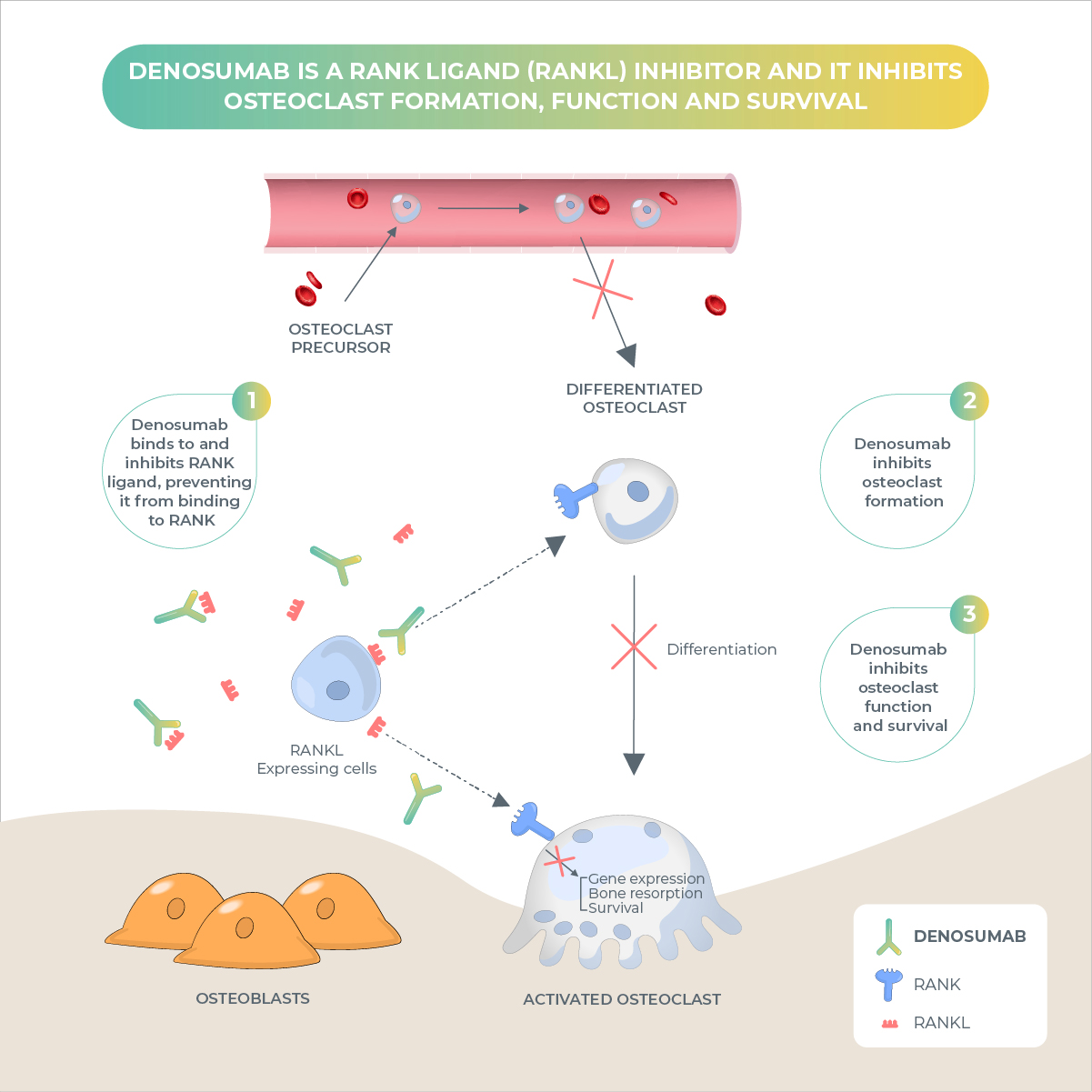
Notes: Denosumab (a fully human monoclonal anti-RANKL antibody) binds to osteoblast-produced RANKL, thereby preventing RANKL from binding to the osteoclast receptor, RANK. By preventing RANKL from binding to RANK, there is less osteoclast genesis and bone-resorbing activity so that bone resorption is markedly suppressed.
Abbreviations:
RANK: receptor activator of nuclear factor-κB;
RANKL: receptor activator of nuclear factor-κB ligand.
Denosumab targets and binds with high affinity and specificity to RANKL, preventing RANKL from activating its only receptor, RANK, on the surface of osteoclasts and their precursors, independent of bone surface (Figure 1).
Prevention of RANKL-RANK interaction inhibits osteoclast formation, function and survival, thereby decreasing bone resorption and increasing bone mass and strength in both cortical and trabecular bone throughout the skeleton.
Additional Resources
 MANTRA PHARMA INC.
Learn more on Mantra Pharma‘s website
References
1. OlsyaMC – Monographie de produit
2. Tsuyoshi Miyazaki, Fumiaki Tokimura & Sakae Tanaka (2014) A review of denosumab for the treatment of osteoporosis, Patient Preference and Adherence, 463-471, DOI: 0.2147/PPA.S46192